Insurance Agent Ad Budget: The Math Your IMO Never Taught You
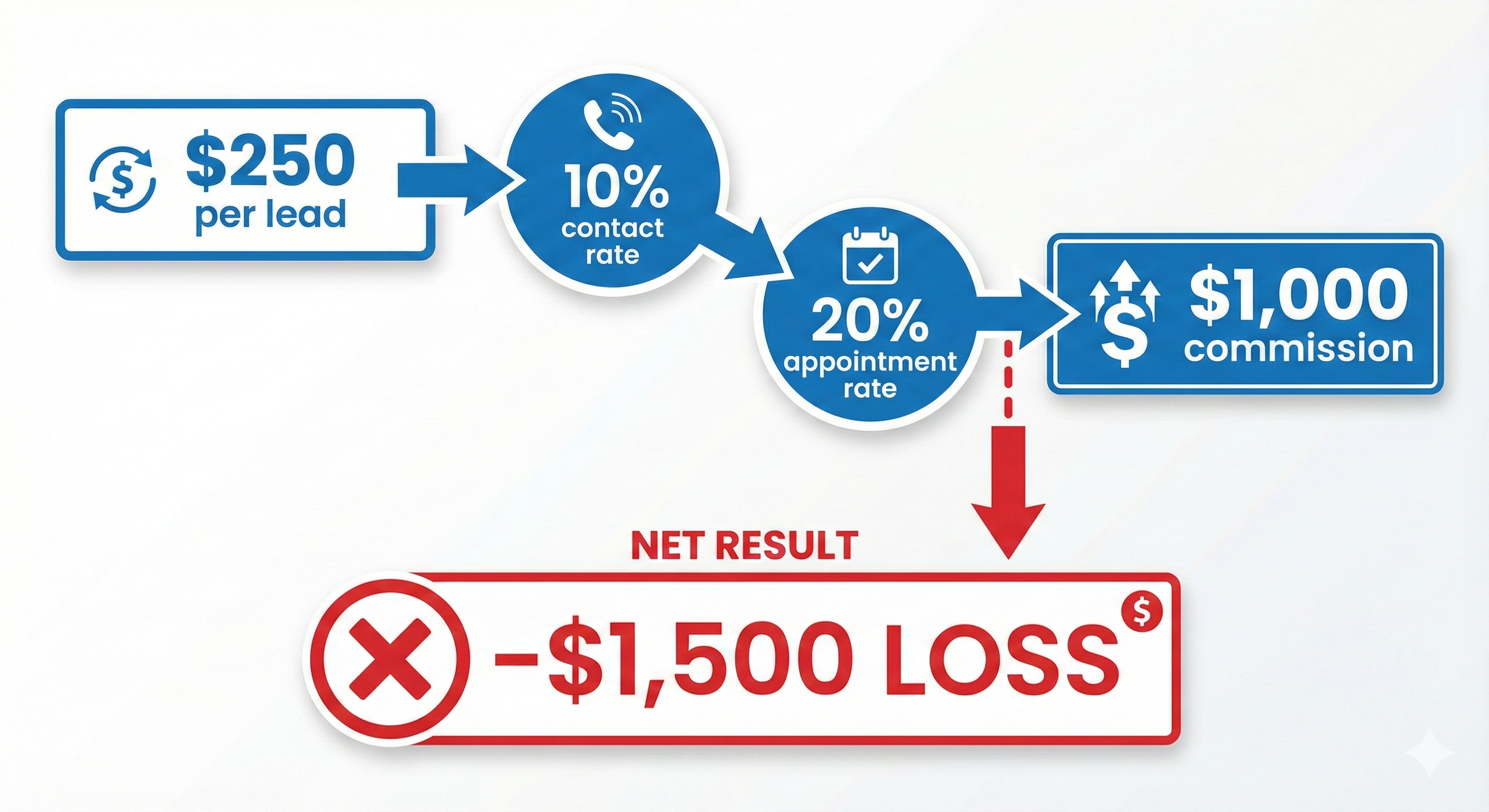
Most agents pick their ad budget the same way they pick a tip at a restaurant — a gut feeling and a prayer that it lands somewhere reasonable.
They look at what they can "afford" that month, pick a number that doesn't make them nervous, and hit go. When the results disappoint, they blame the platform.
Here's the thing: most of them weren't running bad ads. They were running ads without knowing their number. The one number that tells you, before you spend a single dollar, whether your campaign is mathematically capable of being profitable.
That number lives inside your commission structure. And your IMO almost certainly never showed you how to find it.
Your maximum allowable customer acquisition cost is 50% of your average customer value. Find your average commission per issued policy, halve it — that's your ceiling. Every dollar above it loses money. Every dollar below it grows your business. This article shows you how to calculate it before you spend a dollar on ads.
The Wrong Question Agents Ask
"What can I afford to spend this month?"
That is the wrong question because it is emotional. It is based on what is in your bank account right now, not on what your business model can support.
The right question is: what does my commission structure allow me to spend per acquired client?
Think of it like this. Every car has a dashboard — fuel gauge, RPM, temperature, oil pressure. Your job as the driver is to monitor those instruments. Not guess at them. Not hope for the best. Monitor. Your ad campaign works the same way. Before you press the accelerator, you need to know what the gauges are telling you. That is what the KPI Sheet does.
Step 1: Find Your Average Order Value
Your Average Order Value (AOV) is the average commission your business collects per issued client over a defined period. This is your baseline. Everything else builds from it.
Here is how to calculate it:
- Pull your total annualized premium for the last 6-12 months from your IMO dashboard
- Add any excess overfunded premium (infinite banking-style policies)
- Add annuity commission (total deposits × your commission rate — not the deposit amount itself)
- Divide by the number of issued policies only — not submitted, not pending, issued
| Data Point | Example Value |
|---|---|
| Total Annualized IUL/Whole Life Premium | $48,000 |
| Excess/Overfunded Premium | $6,000 |
| Annuity Deposits ($200,000 × 3% commission) | $6,000 |
| Total Annualized Commission | $60,000 |
| Issued Policies | 12 |
| Average Order Value (AOV) | $5,000 |
A lot of people get this wrong by including submitted or declined cases. Only issued policies count. And notice the annuity line — a single $200,000 rollover at 3% commission adds $6,000 to your total. Agents with annuity business almost always have a higher AOV than they realize. That changes everything about what they can afford to spend.
If you are brand new with no production history, use $3,500 as a conservative placeholder. Adjust it as real data comes in.
Step 2: The 50% Rule — Your Hard Ceiling
Here is your most important number.
Maximum Allowable CAC = AOV × 50%
With a $5,000 AOV, your maximum allowable Customer Acquisition Cost is $2,500.
That is the ceiling. Spend more than $2,500 to acquire a single client and you are growing backwards — you are consuming profit faster than you are creating it. Spend less, and you have a compounding machine.
Why 50%? Because the other half funds your overhead, your chargebacks buffer, your savings, and the next month of ads. The 50% Rule is not about being conservative. It is about building a business that survives long enough to scale.
In practice, most agents land between $500 and $1,000 for their maximum allowable CAC. The higher your annuity volume, the higher that number gets. That is one of the real reasons annuity business is worth pursuing — it raises the ceiling on what you can afford to spend to get a client.
Step 3: Cost Per Lead Has Nothing to Do With It
Not so fast on assuming a cheap lead is a good lead.
This is the most common misread in insurance advertising. Agents see $40 leads and call them expensive. They see $8 leads and call them a deal. Neither statement means anything without close rate attached to it.
Watch what happens when you run the same $450 CAC target across three different scenarios:
| Scenario | Cost Per Lead | Close Rate | Leads to Close 1 Client | Actual CAC |
|---|---|---|---|---|
| Strong ads, weak sales | $4.50 | 1% | 100 | $450 |
| Balanced | $5.63 | 1.25% | 80 | $450 |
| Weak ads, strong sales | $45.00 | 10% | 10 | $450 |
All three scenarios produce the exact same Customer Acquisition Cost of $450. Scenario A looks like a steal on paper. Scenario C looks alarming. They are mathematically identical.
This is why cost per lead is what I call Junior Data — it looks important, it is visible, and it is almost completely useless for making decisions. Your CAC is the Senior Data. It is the only figure that tells you whether your campaign is profitable.
In other words: you cannot evaluate your cost per lead without knowing your close rate. And you cannot know your close rate without tracking it. Which is why the daily KPI sheet matters more than any single ad metric.
Step 4: Calculate Your Break-Even ROAS
Return on Ad Spend (ROAS) measures how much revenue you generate per dollar spent. Your break-even ROAS is the floor — the minimum return before you start actually making money.
To find it, you need your real profit margin. Here is the math most agents never see:
| Variable | Value |
|---|---|
| First-Year Commission Rate | 125% |
| IMO Advance Rate (30-day payout) | 75% |
| Effective 30-Day Commission (125% × 75%) | 93.75% |
| Average Death Benefit Allocation | 60% |
| Net Profit Margin | ~45% |
| Break-Even ROAS | 2.22x |
The formula: Break-even ROAS = 1 ÷ 0.45 = 2.22.
What that means in plain language: for every $1 you put into ads, you need $2.22 in total collected annual premium just to break even. For every $100 in ad spend, your target is $18.52 per month in collected life premium. Below that, you're subsidizing your ads out of pocket. Above it, you're profitable.
Write that number on a sticky note and put it somewhere visible. It is the most important single figure in your advertising business.
Step 5: Set Your Monthly Budget With the 14% Rule
Now you have a CAC ceiling. Now you can set a budget that actually means something.
The benchmark that consistently works across growing insurance agencies: spend 14% of your gross income on advertising.
If you collected $150,000 in commissions last year, your advertising budget is $21,000 annually — or $1,750 per month. If you are just starting, work backwards: what monthly production target justifies your ad spend?
Two rules that override everything else:
Rule 1: Never judge results below 2x your maximum CAC.
If your ceiling is $500, you need to spend at least $1,000 before you evaluate anything. The agents who shut off campaigns at $150 spent are the ones who come back a year later saying ads don't work. They do work. You just did not give the math enough runway to breathe.
Rule 2: Audience size caps your daily spend.
A rough benchmark: $1 per day for every 10,000 people in your audience. A 1-million-person audience caps at around $100/day before diminishing returns set in. This matters when you start horizontal scaling across 10-15+ ad sets — your total budget is constrained by audience depth, not just your bank account.
Your Daily KPI Dashboard
Once your campaigns are live, five numbers run the business. Treat these like the gauges on your car dashboard. The fuel gauge does not tell you where to drive — it tells you if you have enough gas to get there. Same idea here.
| KPI | What It Tells You |
|---|---|
| Ad Spend | Is budget deploying as expected? |
| Cost Per Lead | Is the creative performing? |
| Funnel-Booked Appointments | Is your landing page converting? |
| Phone Connections | Are leads picking up? |
| Issued Policies + Target Premium | Is the pipeline closing? |
If cost per lead spikes, that is a creative problem. If appointment rate drops, that is a funnel problem. If connection rate is low, that is a follow-up problem. If close rate slides, that is a sales problem.
The dashboard tells you where the leak is. Not just that there is one.
I want you to wake up and go to sleep to these numbers. Not obsess — monitor. Twenty minutes in the morning is enough. That is what this system is built around.
Check Your Viability Before You Spend a Dollar
Everything above is the math. The problem is that doing it manually — pulling commission statements, calculating advance rates, running three close-rate scenarios, checking your break-even ROAS against your current CPL — takes an hour most agents do not have before they want to launch.
That is why we built the Insurance Ad Viability Calculator.
Drop in your commission structure, your IMO advance rate, and your last 90 days of production. In under two minutes you get:
- Your Average Order Value
- Your Maximum Allowable CAC
- Your Break-Even ROAS
- Your recommended daily budget at 14% of gross
- Your minimum test spend before you can trust the data
It is the KPI Sheet from the section above — pre-built, personalized to your numbers, and free.
Run the Viability Calculator →
The Bottom Line
Your ad budget is not a number you choose. It is a number your commission structure calculates for you. The agents running profitable campaigns are not the ones with the biggest budgets — they are the ones who knew their ceiling before they spent a dollar.
Do the math first. Every time.
Once you have your numbers and you are ready to put them to work, the life insurance lead generation system guide covers how to structure the actual campaigns — the targeting, the testing framework, and the scaling method — that turn a profitable CAC into a consistent, growing pipeline.