Insurance Lead Flow: The Complete System
Most agents think lead generation is the problem. It's not. The problem is lead flow—the systematic process of moving prospects from capture to closed sale. Here's the framework that separates top producers from struggling agents.
Insurance lead flow is the end-to-end system that moves prospects through five stages: capture, qualification, nurture, appointment, and conversion. Each stage has specific metrics, bottlenecks, and optimization tactics. Most agents focus only on stage 1 (generation) and stage 5 (closing), ignoring the 80% of value in stages 2-4. The result: 80-90% of generated leads never convert, even when they're qualified.
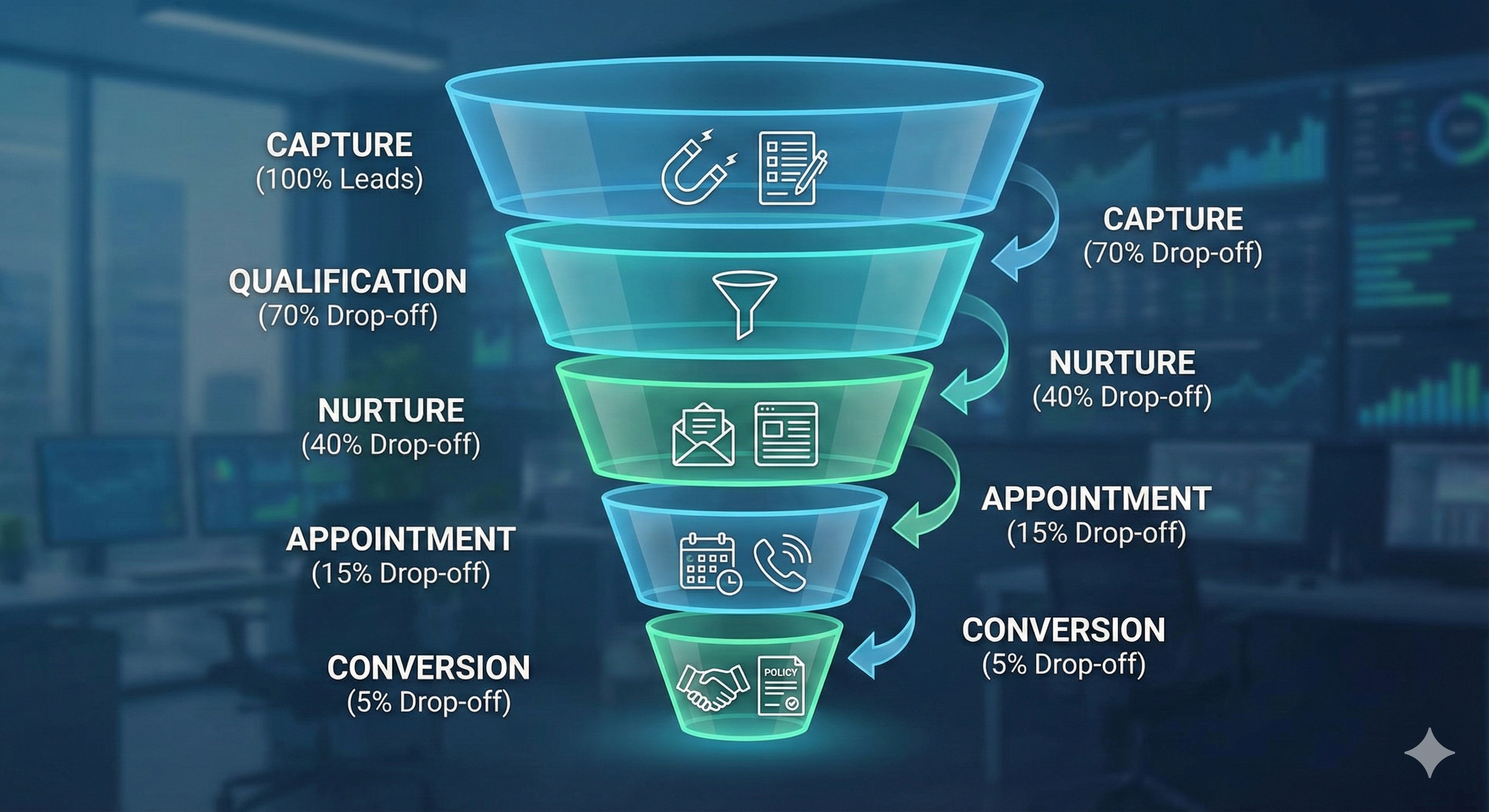
Most agents lose 80-90% of leads between capture and conversion. Here's how to fix it.
The Lead Flow Math: Why Most Agents Lose Money
Let's break down what actually happens to 100 leads in a typical agent's system.
The Typical Agent's Lead Flow
You generate 100 leads this month. Here's what happens:
Stage 1: Capture (100 leads)
- Cost: $2,000 ($20 per lead)
- Result: 100 leads enter your system
Stage 2: Qualification (100 → 30 qualified)
- Conversion: 30%
- Problem: No systematic qualification process
- Result: 70 leads lost (they never respond or aren't qualified)
Stage 3: Nurture (30 → 15 engaged)
- Conversion: 50%
- Problem: No automated follow-up sequence
- Result: 15 leads go cold
Stage 4: Appointment (15 → 8 show up)
- Conversion: 53%
- Problem: No confirmation or reminder system
- Result: 7 no-shows
Stage 5: Conversion (8 → 2 sales)
- Conversion: 25%
- Problem: Prospects aren't pre-framed or warmed up
- Result: 6 appointments don't close
Final Result: 100 leads → 2 sales. Cost per sale: $1,000. Commission: $700 per sale. Total revenue: $1,400. Net loss: $600.
This is why most agents struggle. They're generating leads but losing money because the flow is broken.
The Optimized Lead Flow
Same 100 leads. Same $2,000 investment. Different system:
Stage 1: Capture (100 leads)
- Cost: $2,000
- Optimization: Better landing page with clear value proposition
- Result: 100 leads (same)
Stage 2: Qualification (100 → 60 qualified)
- Conversion: 60% (up from 30%)
- Fix: Automated qualification questions in form
- Result: 40 leads filtered out (saves time)
Stage 3: Nurture (60 → 45 engaged)
- Conversion: 75% (up from 50%)
- Fix: Automated email sequence with valuable content
- Result: 15 leads go cold (down from 70)
Stage 4: Appointment (45 → 36 show up)
- Conversion: 80% (up from 53%)
- Fix: Automated reminders and confirmation system
- Result: 9 no-shows (down from 7)
Stage 5: Conversion (36 → 18 sales)
- Conversion: 50% (up from 25%)
- Fix: Prospects pre-framed through content consumption
- Result: 18 sales (up from 2)
Final Result: 100 leads → 18 sales. Cost per sale: $111. Commission: $700 per sale. Total revenue: $12,600. Net profit: $10,600.
Same leads. Same cost. 9x more revenue. The difference is flow optimization.
The Five Stages: Tactical Frameworks
Stage 1: Capture—Getting Prospects Into Your System
Capture is about getting contact information. Most agents focus on volume. Top agents focus on quality.
The Problem: Generic forms that ask for everything upfront reduce conversion by 30-50%.
The Fix: Progressive profiling. Ask for minimal information first (name and email), then gather more through interactions.
Tactical Framework:
-
Landing Page Optimization
- Single, clear value proposition
- Social proof (testimonials, case studies)
- Mobile-responsive design
- Fast load time (<3 seconds)
-
Form Design
- Maximum 3-4 fields initially
- Clear benefit statement above form
- Privacy assurance
- No required phone number (reduces friction)
-
Value Exchange
- Offer must be worth the information
- Examples: "Free Policy Audit," "5 Questions Every 40+ Year Old Should Ask"
- Deliver immediately upon submission
Metrics to Track:
- Capture rate: Leads captured / Visitors to landing page
- Cost per capture: Ad spend / Leads captured
- Quality score: Percentage of captured leads that are qualified
Common Bottleneck: Low capture rate (below 10%). Fix: Improve landing page value proposition and form design.
Stage 2: Qualification—Separating Buyers from Browsers
Qualification determines if a prospect is a fit. Most agents qualify manually after capture. Top agents qualify during capture.
The Problem: Manual qualification takes 2-3 hours per day and misses 40-60% of qualified leads.
The Fix: Automated qualification scoring based on form responses and behavior.
Tactical Framework:
-
Pre-Qualification Questions
- "What type of insurance are you interested in?" (product fit)
- "When are you looking to purchase?" (timeline)
- "Do you currently have coverage?" (need level)
- "What's your primary concern?" (pain point)
-
Behavioral Scoring
- Pages visited (product pages = higher intent)
- Time on site (longer = more engaged)
- Content consumed (educational content = warmer)
- Email engagement (opens and clicks = interested)
-
Scoring System
- 0-30: Cold (nurture only)
- 31-60: Warm (automated sequence)
- 61-80: Hot (immediate follow-up)
- 81-100: Qualified (book appointment)
Metrics to Track:
- Qualification rate: Qualified leads / Total captured
- Time to qualify: Average hours from capture to qualification
- False positive rate: Qualified leads that don't convert
Common Bottleneck: Low qualification rate (below 40%). Fix: Add qualification questions to capture form and implement behavioral scoring.
Stage 3: Nurture—Building Trust Before the Sale
Nurture is about maintaining engagement between capture and appointment. Most agents send 1-2 emails then give up. Top agents use automated sequences.
The Problem: 60-70% of qualified leads go cold without proper nurture.
The Fix: Automated email sequences that deliver value and build trust.
Tactical Framework:
-
Welcome Sequence (Days 1-7)
- Day 1: Deliver promised content
- Day 3: Educational content (blog post, video)
- Day 5: Case study or testimonial
- Day 7: Soft invitation to book appointment
-
Educational Content
- Answer common questions
- Address objections before they arise
- Position yourself as expert
- No sales pitches (build trust first)
-
Touchpoint Variety
- Email (primary)
- Text messages (for hot leads)
- Social media engagement (if connected)
- Retargeting ads (for website visitors)
Metrics to Track:
- Engagement rate: Opens and clicks / Emails sent
- Nurture conversion: Appointments booked / Leads in nurture
- Time to appointment: Average days from capture to booking
Common Bottleneck: Low engagement rate (below 20%). Fix: Improve email subject lines and content value.
Stage 4: Appointment—Getting Prospects to Show Up
Appointment booking is about converting interest into scheduled meetings. Most agents book appointments manually. Top agents use automated booking systems.
The Problem: 30-50% of booked appointments are no-shows.
The Fix: Automated confirmation and reminder system.
Tactical Framework:
-
Booking System
- Calendar integration (Calendly, Acuity)
- Time zone detection
- Buffer time between appointments
- Automatic rescheduling options
-
Confirmation Sequence
- Immediate confirmation email
- Calendar invite (Google/Outlook)
- 24-hour reminder (email + text)
- 2-hour reminder (text)
-
Pre-Appointment Content
- What to expect document
- Questions to prepare
- Your background/bio
- Meeting agenda
Metrics to Track:
- Booking rate: Appointments booked / Qualified leads
- Show rate: Appointments attended / Appointments booked
- Reschedule rate: Appointments rescheduled / Appointments booked
Common Bottleneck: Low show rate (below 70%). Fix: Implement automated reminders and pre-appointment content.
Stage 5: Conversion—Closing the Sale
Conversion is about turning appointments into sales. Most agents pitch immediately. Top agents consult after building trust.
The Problem: Low close rates (10-25%) because prospects aren't pre-framed.
The Fix: Prospects who've consumed your content close at 40-60% rates.
Tactical Framework:
-
Pre-Framing Content
- Educational videos (10-15 views before appointment)
- Case studies relevant to their situation
- Objection-handling content
- Social proof (testimonials, reviews)
-
Consultation Process
- Discovery questions (understand needs first)
- Education (explain options, not pitch)
- Recommendation (based on their needs)
- Close (ask for decision)
-
Follow-Up Sequence
- Same-day thank you email
- Day 2: Additional resources
- Day 5: Soft check-in
- Day 10: Final follow-up
Metrics to Track:
- Close rate: Sales / Appointments attended
- Average sale value: Total revenue / Sales
- Time to close: Average days from appointment to sale
Common Bottleneck: Low close rate (below 30%). Fix: Improve pre-framing content and consultation process.
The Bottleneck Analysis: Find Your Weakest Link
Your lead flow is only as strong as your weakest stage. Here's how to identify and fix it.
Step 1: Calculate Conversion Rates
Track these metrics for 30 days:
- Capture rate: Leads captured / Visitors
- Qualification rate: Qualified / Captured
- Nurture rate: Engaged / Qualified
- Booking rate: Appointments / Engaged
- Show rate: Attended / Booked
- Close rate: Sales / Attended
Step 2: Identify the Bottleneck
The stage with the lowest conversion rate is your bottleneck. Fix it first.
Example Analysis:
- Capture: 15% (industry average: 10-20%) ✓
- Qualification: 25% (industry average: 40-60%) ✗ BOTTLENECK
- Nurture: 60% (industry average: 50-70%) ✓
- Booking: 40% (industry average: 30-50%) ✓
- Show: 70% (industry average: 70-85%) ✓
- Close: 20% (industry average: 25-40%) ✗
Action: Fix qualification first (bigger impact), then close rate.
Step 3: Implement the Fix
Each bottleneck has specific fixes:
Low Capture Rate (<10%)
- Improve landing page value proposition
- Simplify form (fewer fields)
- Add social proof
- Test different offers
Low Qualification Rate (<40%)
- Add qualification questions to form
- Implement behavioral scoring
- Create lead scoring system
- Filter out unqualified leads early
Low Nurture Rate (<50%)
- Create automated email sequence
- Improve email content value
- Increase email frequency
- Add text message touchpoints
Low Booking Rate (<30%)
- Make booking easier (one-click)
- Add calendar integration
- Offer multiple time slots
- Reduce friction in booking process
Low Show Rate (<70%)
- Implement automated reminders
- Send pre-appointment content
- Confirm appointments 24 hours before
- Make rescheduling easy
Low Close Rate (<25%)
- Improve pre-framing content
- Better discovery process
- Address objections proactively
- Follow up with non-buyers
Step 4: Measure Improvement
After implementing fixes, track metrics for 30 days. Compare to baseline.
Expected Improvements:
- Fixing one bottleneck: 20-50% improvement in overall conversion
- Fixing two bottlenecks: 50-100% improvement
- Fixing all bottlenecks: 200-500% improvement
The Automation Framework: Scale Without Hiring
Manual lead flow doesn't scale. Automation does. Here's the system.
Level 1: Basic Automation (Week 1)
Tools Needed:
- Email marketing platform (Mailchimp, ConvertKit)
- Calendar booking system (Calendly, Acuity)
- CRM (HubSpot, Pipedrive)
Automations:
- Welcome email sequence (3 emails)
- Appointment confirmation emails
- Basic lead scoring
Time Investment: 4-6 hours setup Result: 20-30% improvement in conversion
Level 2: Intermediate Automation (Month 1)
Additional Tools:
- Marketing automation platform
- SMS platform (Twilio, SimpleTexting)
- Landing page builder (Leadpages, Unbounce)
Automations:
- Multi-channel nurture sequence (email + SMS)
- Behavioral lead scoring
- Automated appointment reminders
- Retargeting ads for website visitors
Time Investment: 8-12 hours setup Result: 50-100% improvement in conversion
Level 3: Advanced Automation (Month 2-3)
Additional Tools:
- Advanced CRM with workflows
- AI chatbot for qualification
- Video platform for pre-framing
Automations:
- AI-powered lead qualification
- Personalized content delivery
- Dynamic email sequences based on behavior
- Automated follow-up for non-buyers
Time Investment: 20-30 hours setup Result: 200-500% improvement in conversion
The ROI Math: Why Flow Optimization Beats More Leads
Most agents think: "I need more leads." Top agents think: "I need better flow."
Scenario A: More Leads (Typical Approach)
Current State:
- 100 leads/month
- 2% conversion (2 sales)
- $1,000 cost per sale
- $1,400 revenue
- Net loss: $600
Action: Double lead generation
- 200 leads/month
- 2% conversion (4 sales)
- $1,000 cost per sale
- $2,800 revenue
- Net profit: $800
Investment: $2,000/month (doubling ad spend) ROI: 40% ($800 profit / $2,000 investment)
Scenario B: Flow Optimization (Top Producer Approach)
Current State:
- 100 leads/month
- 2% conversion (2 sales)
- $1,000 cost per sale
- $1,400 revenue
- Net loss: $600
Action: Optimize lead flow
- 100 leads/month (same)
- 18% conversion (18 sales)
- $111 cost per sale
- $12,600 revenue
- Net profit: $10,600
Investment: $1,000 one-time (automation setup) ROI: 1,060% ($10,600 profit / $1,000 investment)
The Math: Flow optimization delivers 26x better ROI than generating more leads.
The Compounding Effect
Flow optimization compounds. Every future lead is more valuable because your system is optimized.
Year 1:
- Month 1-3: Setup and optimization
- Month 4-12: 18% conversion on 100 leads/month
- Total sales: 162
- Revenue: $113,400
- Profit: $95,400
Year 2:
- Same system, same results
- Total sales: 216
- Revenue: $151,200
- Profit: $133,200
Total 2-Year ROI: 22,860% ($228,600 profit / $1,000 investment)
Compare this to buying more leads, which requires ongoing investment with no compounding.
The Implementation Roadmap: 90 Days to Optimized Flow
Here's your step-by-step plan.
Days 1-30: Foundation
Week 1: Audit Current Flow
- Track all metrics for 7 days
- Identify bottlenecks
- Document current process
- Set baseline metrics
Week 2: Fix Capture Stage
- Optimize landing page
- Improve form design
- Test value propositions
- Measure improvement
Week 3: Fix Qualification Stage
- Add qualification questions
- Implement basic scoring
- Create qualification criteria
- Measure improvement
Week 4: Fix Nurture Stage
- Create email sequence
- Write 5-7 emails
- Set up automation
- Measure improvement
Result: 30-50% improvement in overall conversion
Days 31-60: Optimization
Week 5: Fix Appointment Stage
- Set up booking system
- Create confirmation sequence
- Implement reminders
- Measure improvement
Week 6: Fix Conversion Stage
- Create pre-framing content
- Improve consultation process
- Set up follow-up sequence
- Measure improvement
Week 7-8: Advanced Automation
- Implement behavioral scoring
- Add SMS touchpoints
- Create retargeting campaigns
- Measure improvement
Result: 50-100% improvement in overall conversion
Days 61-90: Scale
Week 9-10: Refinement
- A/B test landing pages
- Optimize email sequences
- Improve content based on data
- Measure improvement
Week 11-12: Expansion
- Increase lead generation (now that flow is optimized)
- Scale successful campaigns
- Add new channels
- Measure improvement
Result: 100-200% improvement in overall conversion
The Bottom Line
Insurance lead flow is the system that determines whether you make money or lose it. Most agents generate leads but lose 80-90% due to broken flow. Top producers optimize flow and convert 15-25% of leads into sales.
The math is clear: optimizing lead flow delivers 10-100x better ROI than generating more leads. Same investment. Better results. Compounding returns.
Stop focusing only on lead generation. Start optimizing lead flow. Track metrics at each stage. Fix bottlenecks systematically. Automate what you can. Measure everything.
Whether you build the system yourself or use our done-for-you service, the path is the same: optimize your lead flow, or keep losing money on leads that never convert.
The difference between struggling agents and top producers isn't the number of leads. It's the flow that moves them to revenue.