SEO for Investment Firms: The Lead Generation System That Actually Works
Most investment firms waste $36,000-108,000 on SEO that doesn't work. They rank for keywords nobody searches. They drive traffic that doesn't convert. They wait 12-18 months for results that never come.
The problem isn't SEO. It's the approach. Most firms focus on rankings instead of conversions. They target broad keywords instead of specific client problems. They build content for search engines instead of building trust with prospects.
SEO for investment firms is the process of optimizing your website to rank in search engines for keywords your ideal clients actually search. But ranking is only 20% of the battle. The other 80% is converting visitors into booked appointments. Top firms generate leads at $150-500 per client through SEO. Average firms spend $5,000+ per client and still struggle.
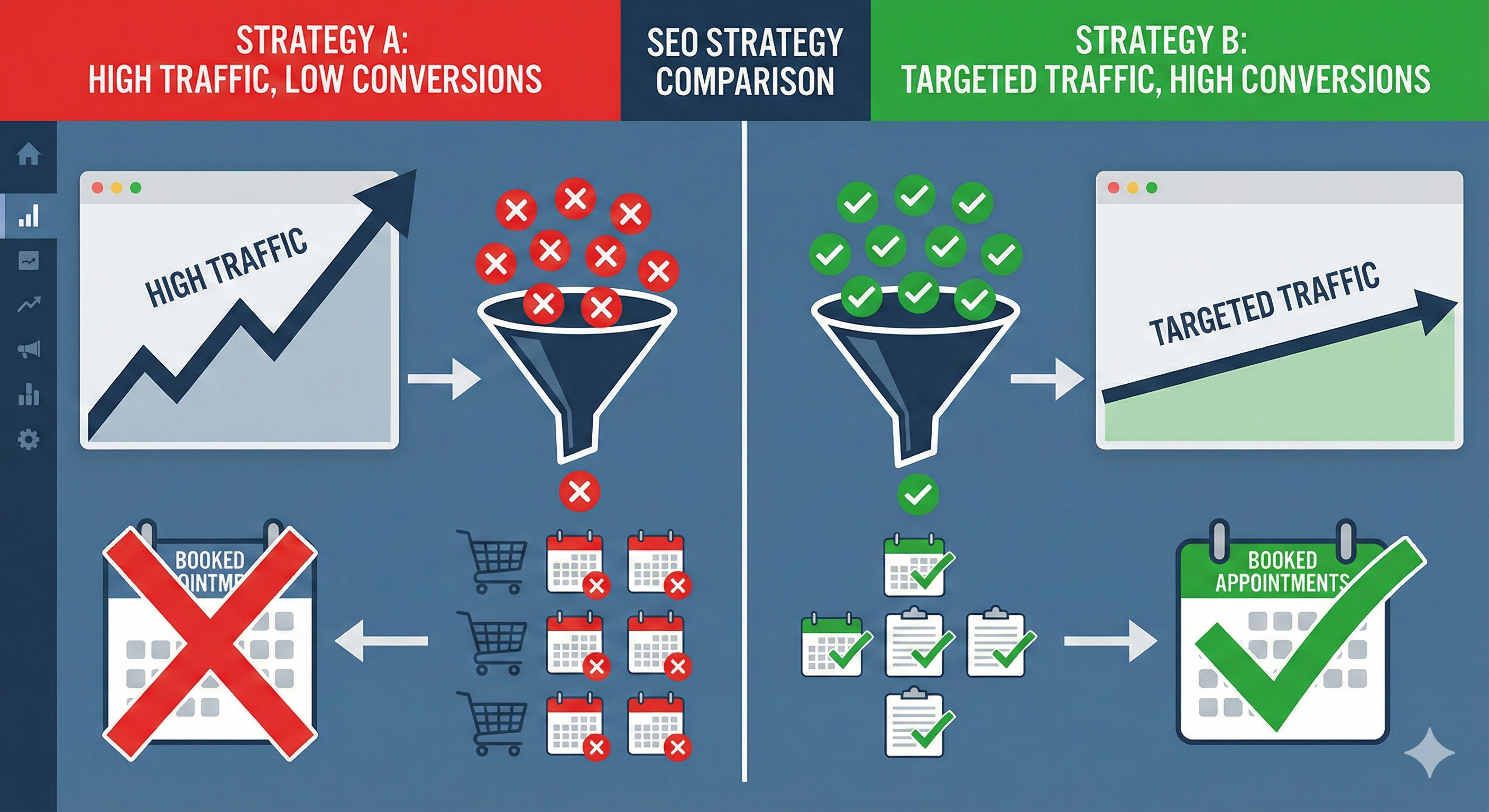
Most investment firms measure SEO wrong. They track rankings instead of revenue.
Why Most Investment Firm SEO Strategies Fail
Most SEO articles tell you the same things: do keyword research, create content, build backlinks. This isn't wrong. It's incomplete. These tactics get you ranked. They don't get you clients.
The Ranking-Without-Results Problem:
You rank #1 for "investment advisor." Great. But here's what nobody tells you: most people searching that term are researching, not buying. They're 6-12 months away from making a decision. They bookmark your site and forget it exists.
The math: 1,000 monthly visitors × 1% conversion rate = 10 leads. 10 leads × 20% close rate = 2 clients. Your effective cost per client: $5,000-10,000. That's not scalable.
The Broad Keyword Problem:
You target "financial advisor" because it has high search volume. So does every other firm in your city. The competition is brutal. You're competing with firms that have 10-year head starts and million-dollar SEO budgets.
Worse, broad keywords attract unqualified traffic. Someone searching "financial advisor" might want hourly consulting, full-service wealth management, or help picking stocks. You can't serve everyone. Your conversion rate suffers.
The Content-Without-Conversion Problem:
You publish 50 blog posts. You rank for 200 keywords. Traffic increases 300%. Appointments increase 10%. Why? Because your content educates but doesn't convert. Visitors read your article, leave, and book with a competitor who asks for the meeting.
Content that ranks but doesn't convert is expensive marketing research for your competitors.
The Technical SEO Trap:
Your SEO agency fixes site speed, mobile optimization, and schema markup. Your rankings improve. Traffic increases. But nothing else changes. Why? Because technical SEO makes your site visible. It doesn't make your site persuasive.
You can't rank your way out of a conversion problem. If your site can't turn visitors into appointments, more traffic just means more waste.
The Conversion-Focused SEO System That Works
Top investment firms don't think about SEO as traffic generation. They think about it as lead generation. Every ranking decision is a conversion decision. Every content piece is a sales tool disguised as education.
Step 1: Target Long-Tail Keywords That Signal Intent
Don't target "investment advisor." Target "retirement planning for physicians in [your city]." The difference? One is research. One is buying intent.
Long-tail keywords have lower search volume. But they have higher conversion rates. Someone searching "retirement planning for physicians" has a specific problem, knows they need help, and is actively looking for a solution. That's your ideal client.
Here's the math:
- "Investment advisor" = 10,000 monthly searches, 0.5% conversion rate, $10,000+ to rank
- "Retirement planning for doctors [city]" = 50 monthly searches, 15% conversion rate, $1,500 to rank
The second option generates more clients for less money. That's strategic SEO.
Step 2: Build Content That Answers Real Questions
Your content shouldn't just rank. It should sell. Every article should answer a specific question your ideal client asks, then guide them to book a consultation. Learn how to create conversion-focused content that drives appointments in our content marketing guide.
Here's the formula:
- Answer the question completely (builds trust)
- Show your expertise (builds authority)
- Make the next step obvious (drives conversions)
Example: Instead of "10 Investment Tips for 2025," write "How Doctors Should Invest Their Practice Sale Proceeds: A Complete Guide." The second title attracts qualified prospects, demonstrates niche expertise, and positions you as the obvious choice.
Step 3: Optimize Every Page for Conversions
Ranking #1 is worthless if visitors leave without booking. Your SEO strategy must include conversion optimization.
Required elements on every page:
- Clear value proposition (what makes you different)
- Social proof (testimonials, case studies, credentials)
- Multiple call-to-action buttons (schedule consultation, download guide, book call)
- Mobile-optimized booking system (prospects book on their phone)
- Trust signals (secure site, compliance disclosures, professional design)
The goal: Make it easier to book than to leave. If someone finds your site through search, they should be able to schedule a consultation in under 60 seconds.
Step 4: Test Keywords with Paid Ads Before Committing to SEO
SEO takes 6-12 months to work. That's a long time to wait if your keywords don't convert. Test them first with paid ads. Use proven ad scripts that convert visitors into booked appointments.
Run Google Ads for 30 days on your target keywords. Track:
- Which keywords drive booked appointments (not just clicks)
- Conversion rates for different keyword groups
- Cost per client acquisition
If a keyword costs $500 per client through ads but would take $10,000 and 12 months to rank for organically, stick with ads. If it converts well through ads, invest in SEO for long-term leverage.
This bullet-before-cannonball approach saves $10,000+ in wasted SEO spend. It's how the top 10% of firms validate strategies before committing resources.
Step 5: Build Authority Through Strategic Link Building
Backlinks signal authority to search engines. But not all backlinks are equal. A link from a local business journal is worth more than 100 links from spam directories.
Focus on quality over quantity:
- Get featured in industry publications (Forbes, InvestmentNews, Financial Advisor Magazine)
- Write guest posts for reputable financial websites
- Build relationships with local business associations
- Create linkable assets (research reports, industry studies, original data)
The goal: Earn links that actual humans see. These build both SEO authority and brand awareness among your ideal clients.
The Math That Matters: ROI of Conversion-Focused SEO
Most investment firms measure SEO wrong. They track rankings, traffic, and keyword positions. These are vanity metrics. They don't measure business impact.
Here's what actually matters:
Traditional SEO Approach:
- Monthly SEO spend: $3,000
- Monthly organic traffic: 5,000 visitors
- Conversion rate: 1%
- Leads generated: 50
- Close rate: 20%
- Clients acquired: 10
- Cost per client: $300
- Wait, that seems good...
But here's the reality:
- 80% of traffic is unqualified (wrong age, wrong net worth, wrong location)
- Effective conversion rate: 0.2% (1% × 20% qualified)
- Qualified leads: 10
- Clients acquired: 2
- Real cost per client: $1,500
Conversion-Focused SEO Approach:
- Monthly SEO spend: $3,000
- Target long-tail keywords with buying intent
- Monthly organic traffic: 800 visitors
- Conversion rate: 8% (higher intent traffic)
- Leads generated: 64
- Qualified rate: 60% (better targeting)
- Qualified leads: 38
- Close rate: 40% (warm leads who researched you)
- Clients acquired: 15
- Cost per client: $200
The conversion-focused approach generates 7.5x more clients for the same SEO spend. The difference isn't traffic. It's strategy.
The Local SEO Advantage for Investment Firms
Most investment firms serve a specific geographic area. But they optimize for national keywords. That's leaving money on the table.
Local SEO targets prospects in your city or region. The competition is lower. The intent is higher. The conversion rates are better.
Google Business Profile Optimization:
Your Google Business Profile is your local SEO foundation. Optimize it completely:
- Accurate business name, address, phone number
- Professional photos (office, team, client meetings)
- Regular posts (market updates, educational content, event announcements)
- Client reviews (respond to every review, positive or negative)
- Services listed (retirement planning, estate planning, investment management)
When someone searches "financial advisor near me," your optimized profile appears first. That's free marketing.
Location-Specific Content:
Create content targeting your local market:
- "Retirement Planning for [City] Business Owners"
- "[City] Estate Planning Guide: What You Need to Know in 2025"
- "How [City] Physicians Should Structure Their Investment Portfolio"
This content ranks for local searches, attracts qualified prospects, and positions you as the local expert. That's strategic SEO.
Local Backlinks:
Build relationships with local organizations:
- Chamber of Commerce
- Industry associations
- Local business publications
- Professional groups
These relationships generate backlinks, referrals, and brand awareness. That's how local SEO works.
Compliance and SEO: Making It Work Together
Investment firms face compliance restrictions. You can't make performance claims. You can't guarantee returns. You can't use testimonials without disclosures. But that doesn't mean you can't do effective SEO.
Educational Content Strategy:
Focus on education, not promotion. Write about strategies, trends, and best practices. Don't sell. Educate. Compliance loves educational content. So do search engines.
Disclosure Best Practices:
Include compliance disclosures on every page:
- "Investment advisory services offered through [firm name], a registered investment advisor."
- "Past performance does not guarantee future results."
- "This content is for educational purposes only and does not constitute financial advice."
These disclosures protect you legally and signal professionalism to prospects. That's smart SEO.
Approved Language Templates:
Work with compliance to create approved language templates. Use these for:
- Service descriptions
- Value propositions
- Case studies (anonymized)
- Educational content
This speeds up content creation and ensures compliance. That's efficient SEO.
How to Choose an SEO Provider for Your Investment Firm
Most SEO agencies don't understand investment firms. They optimize for traffic, not conversions. They target broad keywords, not specific client problems. They focus on rankings, not revenue.
What to Look For:
-
Financial services experience: They've worked with investment firms, RIAs, or wealth managers before. They understand compliance requirements and industry nuances.
-
Conversion focus: They optimize for booked appointments, not just rankings. They ask about your conversion rates, not just your traffic.
-
Transparent reporting: They show you which keywords drive booked appointments, not just rankings. They report on business metrics, not vanity metrics.
-
Strategic keyword selection: They recommend long-tail keywords with buying intent, not just high-volume terms. They validate keywords with paid ads before committing to SEO.
-
Content strategy: They create educational content that builds trust and drives conversions, not keyword-stuffed articles that rank but don't convert.
Red Flags to Avoid:
- Guarantees #1 rankings (nobody can guarantee rankings)
- Focuses only on traffic, not conversions
- Targets only broad keywords
- No financial services experience
- Vague reporting without business metrics
- One-size-fits-all approach
The Hybrid Approach:
Consider hiring SEO agencies for technical work (site speed, mobile optimization, link building) but keep conversion optimization in-house. You understand your clients better than any agency. You know what converts. That's your competitive advantage.
Measuring SEO Success: The Metrics That Matter
Stop tracking rankings. Start tracking revenue.
Primary Metrics:
- Booked appointments from organic search
- Cost per client acquisition from SEO
- Conversion rate of SEO traffic to appointments
- Lifetime value of SEO-acquired clients
Secondary Metrics:
- Organic traffic (trend direction matters, exact numbers don't)
- Keyword rankings (track the top 20, not just #1)
- Backlink growth (quality over quantity)
The Dashboard That Matters:
Create a simple dashboard tracking:
- Monthly SEO spend
- Monthly booked appointments from organic search
- Cost per appointment
- Close rate of SEO appointments
- Revenue generated from SEO
If your SEO spend is $3,000 monthly and generates 10 appointments that close at 40%, resulting in 4 clients with $5,000 annual revenue each, your SEO ROI is 267%. That's how you measure SEO success.
The Bottom Line: SEO That Converts, Not Just Ranks
SEO for investment firms isn't about rankings. It's about revenue. Most firms waste $36,000-108,000 on SEO that generates traffic but not clients. The top 10% focus on conversion-optimized SEO that generates leads at $150-500 per client.
The difference isn't tactics. It's strategy. Target long-tail keywords with buying intent. Create content that answers real questions and drives conversions. Optimize every page for booked appointments. Test keywords with paid ads before committing to SEO. Measure revenue, not rankings.
If your SEO doesn't generate booked appointments, it's not working. Traffic without conversions is worthless. Rankings without revenue are vanity metrics.
Stop measuring SEO wrong. Start measuring revenue. That's how investment firms win with SEO.
If you're ready to generate leads while your SEO builds, check out our instant leads system that delivers qualified appointments in 24 hours. Or learn to build your own lead generation system with our Generate Leads courses.