Effective Insurance Ads: The System That Beats Cold Calling
Most insurance ads fail because agents copy what doesn't work.
They see GEICO's gecko. State Farm's jingles. Allstate's mayhem character. They think "that's effective advertising." Then they run generic ads that get clicks but no appointments. They spend $5,000 to generate 50 leads that close at 5%.
Effective insurance ads are short video systems that educate prospects before selling, build trust through expertise, and drive qualified appointments that close at 25-40% instead of 2-5%. They use specific messaging about real problems, clear offers that solve those problems, and landing pages that capture contact information in exchange for value.
Here's the system that beats cold calling. For a broader look at advertising for insurance across all channels, read that guide first.
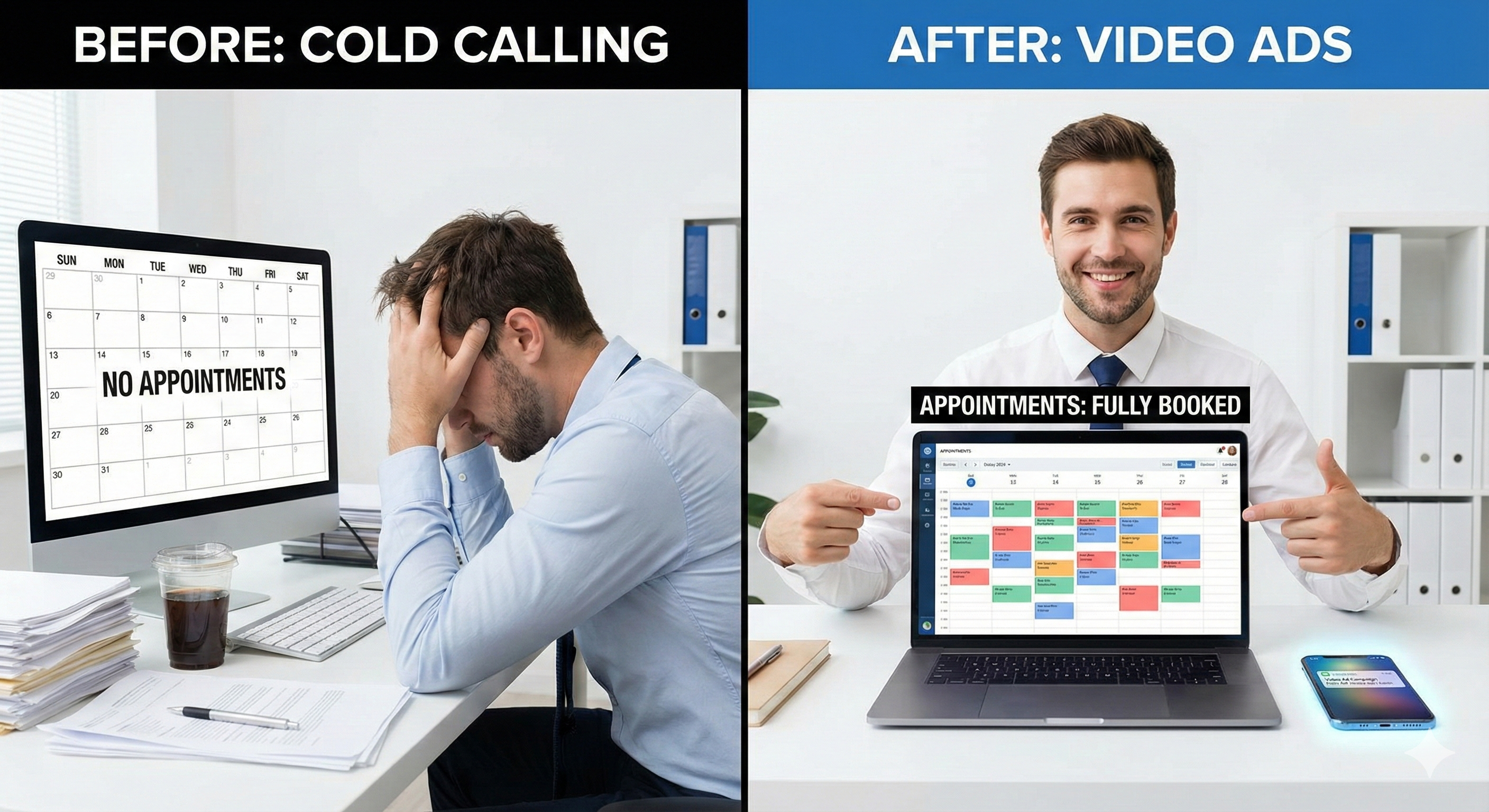
Most agents waste money on ads that don't book appointments. The system beats the spend.
Why Most Insurance Ads Fail
Big brand ads don't work for individual agents because they have different goals.
Big brands want: Brand awareness. Market share. Top-of-mind recognition when you're ready to shop.
You want: Booked appointments this month. Qualified leads that show up. Closed policies that pay commissions.
A GEICO commercial that makes you laugh doesn't make you call. It makes you remember GEICO when you're shopping for insurance. But you're not GEICO. You need results this month, not next year.
Here's what happens when agents copy big brand strategies:
They run awareness ads: Generic messages like "Get great coverage" or "Save on insurance." These ads get impressions but no appointments.
They skip the education step: They assume prospects know they need insurance. They jump straight to "buy now." But prospects don't trust ads. They trust education.
They use weak offers: "Free quote" is not an offer. Everyone offers free quotes. Your offer must solve a specific problem prospects are searching for right now.
They don't track what matters: They track clicks, impressions, and reach. They should track appointments booked, appointment show rate, and close rate. Awareness metrics don't pay commissions.
Effective ads reverse this process. They educate first, build trust second, and ask for appointments third.
The Effective Insurance Ad Formula
Effective insurance ads follow a simple formula that most agents skip:
Problem → Education → Offer → Appointment
Step 1: Identify a Specific Problem
Don't say "need insurance." Say "coverage gap that leaves your family vulnerable" or "overpaying for term life when whole life costs the same."
Effective ads target prospects who are actively searching for solutions. They use specific language that matches search intent.
Weak: "Need life insurance? Get a quote today."
Effective: "Are you leaving your family with $200,000 in debt if you die? Here's how to protect them for $50 a month."
The difference is specificity. Generic messages get ignored. Specific problems get attention.
Step 2: Educate Before Selling
Prospects don't trust ads. They trust education.
Effective ads teach prospects something valuable before asking for anything. They explain how coverage gaps work. They show how to calculate life insurance needs. They reveal common mistakes that cost thousands.
Weak: "Buy our insurance. We're the best."
Effective: "Most people buy term life insurance because they think whole life is expensive. But here's the math: Term life costs less now, but if you live past the term, you lose everything. Whole life costs more now, but builds cash value you can use while you're alive. Here's when each makes sense."
Education builds trust. Trust generates appointments. Appointments close policies. Need more ideas beyond ads? Our list of insurance marketing ideas covers organic and paid strategies you can combine.
Step 3: Make a Clear Offer
"Free quote" is not an offer. Everyone offers free quotes.
Effective ads offer something specific that solves the problem you identified. A coverage gap calculator. A cost comparison guide. A mistake audit that reveals hidden costs.
Weak: "Get a free quote."
Effective: "Download our 'Coverage Gap Calculator' to see exactly how much insurance you need based on your debts, income, and family situation. Takes 2 minutes. Shows you the real number."
The offer must be valuable enough that prospects exchange their contact information. But simple enough that they can consume it quickly.
Step 4: Drive to a Landing Page
Don't send prospects to your website homepage. Send them to a landing page built for one goal: capture contact information.
Effective landing pages have:
- Headline that repeats the problem
- Bullet points that explain the offer value
- Simple form (name, email, phone)
- Clear call-to-action button
No navigation menu. No blog links. No distractions. Just the offer and the form.
When prospects submit the form, they get immediate access to the offer. Then they enter your follow-up system that books appointments automatically.
What Makes Insurance Ads Effective: The Math
Effective ads don't just look good. They hit specific numbers that pay commissions.
Cost per appointment: $50-150
Generic ads cost $200-500 per appointment because they're targeting cold audiences. Effective ads cost less because they're targeting warm audiences who are actively searching for solutions.
Appointment show rate: 70%+
Cold leads show up 40-50% of the time. Pre-sold leads show up 70%+ because they've watched your video, consumed your content, and booked because they trust you.
Close rate: 25-40%
Generic leads close at 2-5% because you're starting cold. Branded leads close at 25-40% because prospects are pre-sold before the appointment.
Cost per client: $150-500
Here's the math: $100 cost per appointment × 75% show rate × 30% close rate = $444 cost per client. Compare that to $2,500-5,000 per client from cold calling or shared leads.
The system pays for itself. Generic ads don't.
Platform Strategy: Where Effective Ads Live
Not all platforms work the same way. Effective ads choose platforms based on goals.
Facebook and Instagram: Best for Education
Facebook and Instagram video ads work best for insurance agents because they let you show your face and build trust before asking for meetings.
Why they work:
- Video format lets you educate naturally
- Targeting options find prospects actively searching for insurance
- Lower cost per click than Google ($1-3 vs $5-15)
- Retargeting keeps your message in front of interested prospects
Best ad format: 30-90 second videos that answer a specific question, then drive to a landing page with a valuable offer. To see how agents use video as the core of their lead system, read about life insurance ads and pre-branded video leads.
Example: "Are you paying too much for life insurance? Most people overpay by $50-100 a month because they don't know how to compare policies. Here's a 2-minute guide that shows you exactly what to look for. Click below to get it free."
Google Ads: Best for Immediate Buyers
Google Ads work for prospects who are ready to buy right now. But they cost 3-5x more than Facebook because everyone competes for the same keywords.
Why they work:
- Prospects are actively searching ("life insurance quotes")
- High intent means faster conversions
- Search ads match exactly what prospects are looking for
Why they're expensive:
- Competition drives up costs ($10-30 per click)
- Generic keywords cost more than specific ones
- You're competing with big brands with bigger budgets
Best use case: Run Google Ads for specific, high-intent keywords ("term life insurance calculator") and use Facebook for broader education campaigns. If Facebook is your primary channel, our step-by-step guide on how to generate life insurance leads on Facebook covers the exact setup.
YouTube: Best for Long-Form Education
YouTube works for agents who want to build authority through longer content. But it takes longer to see results because prospects need to watch multiple videos before booking.
Why it works:
- Longer videos (5-15 minutes) build deeper trust
- Subscribers return for more content
- YouTube search ranks your videos for relevant keywords
Why it's slow:
- Prospects need multiple touchpoints before booking
- Takes 30-90 days to build a subscriber base
- Hard to track direct ROI from video views
Best use case: Use YouTube as part of a content system, not as your only ad channel. Post weekly videos that educate, then run Facebook ads that retarget YouTube viewers.
Copywriting Secrets: How to Write Ads That Convert
Effective ads use specific copywriting formulas that most agents never learn.
The Attention Formula
Hook: Start with a question or bold statement that stops scrolling.
Example: "Did you know 70% of life insurance policies are underinsured? That means if you die, your family gets half of what they need."
Why it works: Questions engage the brain. Bold statements create curiosity. Both stop scrolling.
The Trust Formula
Social proof: Use numbers, statistics, or testimonials that prove your expertise.
Example: "I've helped 247 families avoid coverage gaps that would have cost them $500,000 in protection. Here's what I learned."
Why it works: Specific numbers build credibility. Stories create connection. Both build trust.
The Urgency Formula
Time or scarcity: Create a reason to act now, not later.
Example: "Coverage gaps don't wait. If something happens before you fix it, your family pays the price. Download the calculator below and fix it in the next 10 minutes."
Why it works: Urgency drives action. Without it, prospects bookmark your ad and never return.
The Clarity Formula
Simple language: Use short sentences and common words. If a sentence takes two breaths to read, cut it in half.
Weak: "Utilize our comprehensive insurance solutions to optimize your financial security and mitigate potential risks."
Effective: "Protect your family for $50 a month. Here's how."
Why it works: Clarity beats complexity. Prospects don't have time to decode jargon. They want answers, not explanations.
Visuals That Work: What Effective Ads Look Like
Effective insurance ads don't need expensive production. They need clear visuals that support the message.
Video Ad Best Practices
Length: 30-90 seconds. Short enough to watch fully. Long enough to educate.
Format: Talking head or screen recording. You don't need actors or scripts. You need authenticity.
Visuals: Simple graphics that support your points. Charts, numbers, or bullet points on screen while you talk.
Audio: Clear voice, background music (optional), no distracting sounds.
Example structure:
- 0-5 seconds: Hook question
- 5-30 seconds: Problem explanation
- 30-60 seconds: Solution education
- 60-90 seconds: Offer and call-to-action
Image Ad Best Practices
Headline: Large, bold text that repeats the problem.
Visual: Simple graphic or photo that supports the message. No clutter.
Offer: Clear button or text that explains what prospects get.
Example: Headline says "Coverage Gap Calculator" with a simple graphic showing a family and a calculator. Button says "Get Free Calculator."
Landing Page Best Practices
Headline: Repeats the problem from the ad.
Subheadline: Explains the offer value.
Bullet points: 3-5 benefits of the offer.
Form: Name, email, phone only. Keep it simple.
Button: Clear action like "Get Free Calculator" or "Download Guide."
Social proof: Testimonial or number that builds trust ("Downloaded by 1,247 agents").
No navigation. No blog links. No distractions. Just the offer and the form.
Common Mistakes That Kill Insurance Ads
Most agents make the same mistakes that destroy ad performance.
Mistake 1: Copying Big Brand Campaigns
The problem: GEICO's caveman, State Farm's Jake, Allstate's Mayhem work for brand awareness, not lead generation.
The fix: Learn their messaging principles (clarity, emotion, simplicity) but adapt to your goal: booked appointments, not brand recall.
Mistake 2: Skipping the Education Step
The problem: Agents assume prospects know they need insurance. They jump straight to "buy now."
The fix: Educate first. Explain the problem. Show the solution. Then ask for the appointment.
Mistake 3: Using Weak Offers
The problem: "Free quote" is not an offer. Everyone offers free quotes.
The fix: Offer something specific that solves a problem: calculator, guide, audit, comparison tool.
Mistake 4: Sending to Website Homepage
The problem: Homepages are designed for navigation, not conversion. Prospects get distracted and leave.
The fix: Build landing pages with one goal: capture contact information. No navigation, no links, just the offer and the form.
Mistake 5: Tracking Wrong Metrics
The problem: Agents track clicks, impressions, reach. These don't pay commissions.
The fix: Track cost per appointment, appointment show rate, and close rate. These determine profitability.
Mistake 6: Giving Up Too Early
The problem: Ads need 30-90 days to optimize. Agents quit after 2 weeks.
The fix: Run ads for at least 30 days. Test different headlines, offers, and visuals. Optimize based on data, not feelings.
The Effective Insurance Ad System: How to Start
Effective ads aren't one-off campaigns. They're systems that run continuously and improve over time.
Phase 1: Setup (Week 1)
Choose one platform: Start with Facebook or Instagram. Master one platform before adding others.
Create one offer: Build a landing page with a valuable offer (calculator, guide, audit).
Produce one video: Record a 60-second video that educates on one problem and drives to your landing page.
Set a budget: Start with $500-1,000 per month. This gives you enough data to optimize without breaking the bank.
Phase 2: Launch (Week 2-4)
Run the ad: Launch your video ad to a warm audience (people interested in insurance).
Track metrics: Monitor cost per click, landing page views, form submissions, and appointments booked.
Optimize daily: Pause ads that don't perform. Increase budget on ads that do. Test new headlines and visuals.
Goal: Get 10-20 appointments in the first month at $50-150 cost per appointment.
Phase 3: Scale (Month 2+)
Expand winning ads: Once an ad works, create variations (different headlines, visuals, offers).
Add retargeting: Show ads to people who visited your landing page but didn't submit the form.
Test new platforms: Add Google Ads for high-intent keywords. Add YouTube for long-form education.
Increase budget: As you prove ROI, increase monthly spend. $3,000 per month with branded leads beats $10,000 with cold leads.
Goal: 30-50 appointments per month at $50-150 cost per appointment with 25-40% close rates.
Effective Insurance Ads: Real Examples That Work
Here are real ad examples that agents use to book appointments.
Example 1: Coverage Gap Calculator
Headline: "Are You Leaving Your Family With $200,000 in Debt?"
Video script: "Most people think they have enough life insurance. But here's the truth: 70% of policies are underinsured by $200,000 or more. That means if you die, your family gets half of what they need. I created a free calculator that shows you exactly how much coverage you need based on your debts, income, and family situation. Takes 2 minutes. Click below to get it."
Landing page: Simple form with headline "Coverage Gap Calculator" and 3 bullet points explaining what prospects learn.
Result: $75 cost per appointment, 80% show rate, 35% close rate = $214 cost per client.
Example 2: Term vs Whole Life Comparison
Headline: "Term Life vs Whole Life: The Math Most Agents Won't Show You"
Video script: "Most agents sell term life because it's easier. But here's what they don't tell you: If you live past the term, you lose everything. Whole life costs more now but builds cash value you can use while you're alive. I created a free comparison guide that shows you exactly when each makes sense. Click below to get it."
Landing page: Form with headline "Term vs Whole Life Comparison Guide" and benefits listed.
Result: $90 cost per appointment, 75% show rate, 30% close rate = $300 cost per client.
Example 3: Medicare Supplement Mistakes
Headline: "3 Medicare Mistakes That Cost Seniors $5,000 Per Year"
Video script: "Most seniors overpay for Medicare supplements because they don't know how to compare plans. I've seen seniors pay $300 per month when they could pay $150 for the same coverage. I created a free guide that shows you the 3 mistakes to avoid. Takes 5 minutes to read. Click below to get it."
Landing page: Form with headline "Medicare Mistakes Guide" and testimonial from a saved client.
Result: $60 cost per appointment, 85% show rate, 40% close rate = $150 cost per client.
Measuring Success: The Metrics That Matter
Effective ads track metrics that pay commissions, not metrics that look good in reports.
Primary Metrics
Cost per appointment: Target $50-150. If higher, your offer isn't strong enough or your targeting is too broad.
Appointment show rate: Target 70%+. If lower, prospects aren't pre-sold enough before booking.
Close rate: Target 25-40%. If lower, your offer doesn't match the appointment conversation.
Cost per client: Target $150-500. This is the number that determines profitability.
Secondary Metrics
Cost per click: Monitor but don't optimize for it. A $10 click that books an appointment is better than a $1 click that doesn't.
Landing page conversion rate: Target 15-25%. If lower, your landing page doesn't match your ad message.
Video completion rate: Target 50%+. If lower, your hook isn't strong enough or your video is too long.
Return on ad spend (ROAS): Target 3-5x. For every $1 spent on ads, you should generate $3-5 in commissions (after accounting for close rates and average policy value).
The Bottom Line: Effective Ads Are Systems, Not Campaigns
Effective insurance ads don't happen by accident. They're systems that run continuously, improve over time, and generate appointments that close at 25-40% instead of 2-5%.
Most agents waste money on ads that don't work because they copy what doesn't apply to them. They run awareness ads when they need lead generation ads. They track clicks when they should track appointments. They give up too early when they should optimize longer.
The system is simple: Identify a problem. Educate on the solution. Make a clear offer. Drive to a landing page. Track appointments, not clicks.
But simple doesn't mean easy. It takes work to create effective ads. It takes testing to find what works. It takes patience to optimize over time.
The agents who do this work book more appointments than agents who cold call. They close more policies than agents who buy shared leads. They build sustainable businesses that don't depend on referrals or luck.
If you're ready to build an effective ad system, start with one platform, one offer, and one video. Master that before adding complexity. Track the metrics that matter. Optimize based on data, not feelings.
The system works. But only if you work the system.
Download our free ad scripts that agents use to book 20+ appointments per month.
Or get pre-branded leads that are already watching your videos before booking appointments.